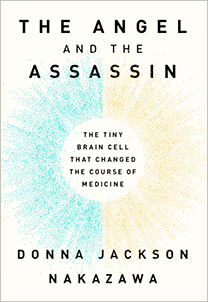
The Angel and The Assassin: Book Launch and Tour Info
Dear all, The Angel and the Assassin: The Tiny Brain Cell that Changed the Course of Medicine will be out in just 6 days! If you haven’t yet, I hope you’ll consider pre-ordering from your local bookstore or seller of your choice! You can also check out this review in Kirkus, or read the prologue here! And, I have a piece about the book coming out in Wired magazine on January 21, as well as OpEds in The Boston Globe and STAT, so keep your eyes peeled! I’m heading out on tour starting on the 21st, and would love to see your lovely faces! All the details are on my website, but here’s a quick look at where I’ll be over the next month. Let me know if you’re coming on Facebook or Twitter or Instagram! Invite your friends! Come and ask me questions! JANUARY 21 – BALTIMOREThe Ivy Bookstore – 7:00 pmIn conversation with Sheilah Kast, host of On the Record, WYPR, Baltimore’s NPR News Station, with book signing and wine tasting to follow, courtesy of Peter Wood of The French Paradox (Voted Best Wine Store in Baltimore)! JANUARY 30 – CAMBRIDGE, MAHarvard Science Center – 6:00 pmHarvard Division of Science, Harvard Cabot Science Library Series, Harvard BookstoreIn conversation with Carey Goldberg, host of CommonHealth, WBUR, Boston’s NPR Station, and the brilliant Beth Stevens Ph.D., MacArthur Fellow and Howard Hughes Medical Institute Investigator FEBRUARY 5 – BELMONT, MABelmont Books – 7:00 pmIn conversation with the amazing Bina Venkataraman, editorial page editor, The Boston Globe, and author of the amazing book The Optimist’s Telescope FEBRUARY 10 – BROOKLYN, NYWord Books – 7:00 pmA Sob Sisters event organized by the sensational trio of New York Times bestselling writers, Susannah Cahalan, Ada Calhoun, Karen AbbottIn conversation with Kate Winkler Dawson, author of the wonderful book, American SherlockSign up here FEBRUARY 12 – ANNAPOLIS, MDEastport Library – 6:30 pmCommunity Foundation of Anne Arundel County and Old Fox BooksIn conversation with the brilliant Christina Bethell, Ph.D., professor of public health at Bloomberg School of Health at Johns Hopkins FEBURARY 15 – HARRISBURG, PAMidtown Scholar – 5:00 pmIn conversation with Brett Sholtis, reporter for Transforming Health, WITF, Harrisburg’s NPR News Station Those are the dates! I so hope to see you there! Thank you all for your help and support- please feel free to post and share this widely! – Donna
The Angel and the Assassin: The Tiny Brain Cell that Changed the Course of Medicine
My new book, THE ANGEL AND THE ASSASSIN: THE TINY BRAIN CELL THAT CHANGED THE COURSE OF MEDICINE will be out in just 2 months, on January 21st, 2020! After two years of reporting, researching, writing, factchecking, I can’t wait to share it with you!
Why We Need to Talk About the Unique Biological Effects of #ToxicChildhoodStress and #FemaleAdversity on Women’s Bodies and Brains.
The Female Body and Brain on Toxic Stress (CRUCIAL NOTE HERE BEFORE YOU READ: Boys’ immune systems become dysregulated in response to #toxicstress too, and that leads to disease and changes to the brain that we also need to talk about more openly AND compassionately. Today I’m focusing on girls’ unique immune response to #toxicstress.) So, exactly what happens in a girl’s body, in response to #toxicstress, that leads girls to be more likely to be ill as adult women? EVERY WOMAN WAS ONCE A GIRL. So, we should figure this conundrum out, right? (For more on the scientific link between toxic childhood stress, being female, and later developing autoimmune disease, depression and other conditions, please read PART I of this essay, Why Girls Who Face Toxic Stress are More Vulnerable to Adult Illness: The Shocking Relationship Between Being Female, #ACEs, Autoimmune Disease and Depression) Well, it turns out that girls’ developing immune systems react differently to toxic stress than boy’s do. This is because of some basic physiological differences between women and men. Women are, generally, physically smaller than men and our hearts and lungs are much smaller in size. Yet our anatomy makes added room to carry a fetus in order to create new human life. Our smaller heart, lungs, and organs still have to be able to do everything a human male does – pump oxygen, circulate blood, run fast, think fast, be awake 16 or 17 hours a day – and have the necessary fuel to carry a child to term. We have to do double duty, on half the machinery. Women can do so much more on less because we also have higher baseline levels of the hormone estrogen. Estrogen acts as a kind of messenger, carrying information between groups of our cells. Say we are stressed, or catch a flu, or get a vaccine – estrogen helps us, as women, have a more robust immune response. This more robust immune response is also thanks to steroid hormones known as glucocorticoids (or GCs). Glucocorticoids are produced by the adrenal gland and are anti-inflammatory. They help regulate inflammation. If a woman is pregnant, glucocorticoids help us to keep our baby safe and carry it to term, even if we come down with the flu, or have a physical injury. Our immune system is poised, all the time, to protect our ability to carry another life. This heightened female immune response also means that when our immune system sets out to fight off any foreign invader, such as a virus or bacteria, as women we also produce more of what are called antibodies, or fighter immune cells. That’s good. BUT it can also be a problem. As women, when we produce more antibody fighter cells, we also produce more autoantibodies. Autoantibodies are rogue fighter immune cells that can mistakenly attack the body’s own tissue or organs, in what we refer to as friendly fire. As in #autoimmunedisease. When women, ESPECIALLY GIRLS, repeatedly face #toxicstress during the developmental years, over time, their stress response begins to be dysregulated. Glucocorticoids, or GCs, become less able to properly regulate a healthy, appropriate immune response, which leads to more inflammation. Now remember, in the face of threats that prick up the immune system (which includes infections, physical injury, AND social threats and stressors), girls ALSO make more antibodies AND more rogue autoantibodies – again, because we have so much more estrogen. This leads to a double whammy. It’s a simple equation: A (Glucocorticoids stop regulating a proper immune response in face of #toxicstress) + B (Estrogen leads to production of more autoantibodies, which can attack the body itself) = C (When girls face toxic stress, rogue autoantibodies can run amok, promoting slow-brew inflammation, and later disease) This means that, over time, a woman’s immune system is a lot more likely to begin to attack her own body. This accounts for the fact that #autoimmunediseases strike women at three times the rate of men. For some illnesses that ratio is far higher. Examples. Women develop Hashimoto’s thyroiditis at a rate of 10:1 compared with men. In lupus, that rate is 9:1. In Sjögren’s syndrome, 9:1. #AutoimmuneDisease is one of the top ten leading causes of death in women under the age of sixty-five. Fifty million Americans have an autoimmune disease, and three-quarters of these are women. Women are also twice as likely as men to have chronic pain syndromes. Women with an ACE score of 3 are significantly more likely to have chronic pain syndromes including headaches, back and neck problems. Women are also more likely to have “contested conditions” – meaning the medical profession is still debating whether these autoimmune conditions are real or just psychosomatic — such as #chroniclyme, #chronicfatigue and #fibromyalgia. A heightened inflammatory stress response also affects the architecture of the #femalebrain differently than the male brain. A girl’s brain, on adversity, is a vulnerable brain in unique ways. For instance, both boys and girls who grow up with #toxicstress demonstrate, on brain scans, fewer neural connections between the pre-frontal cortex (the decision-making center of the brain) and the hippocampus (an area of the brain that helps us to make sense of our emotions and experiences). But, in girls who grow up with #toxicstress and #ACEs, another area of neural connectivity is affected. It goes offline. Synaptic connections between an area of the brain known as the amygdala (the fear-and-alert center of the brain) and the pre-frontal cortex are also weakened. This means that girls who experience #ACEs are more likely to grow up in a chronic state of hypervigilance. Fight or flight. Feeling that life is an emergency. This contributes to the fact that girls and women are more likely to suffer from anxiety and depression as adults than are men. Stats bear this out. One third of men with an #ACE Score of 4 later develop depression—already a high and disturbing figure—while nearly 60 percent of women with 4 #ACEs develop chronic depression in adulthood. That
Childhood Trauma Leads to Lifelong Chronic Illness — So Why Isn’t the Medical Community Helping Patients?
Hi All, I hope you’ll enjoy this essay I wrote for Huffington Post, “Childhood Trauma Leads to Adult Chronic Illness — So Why Isn’t the Medical Community Helping Patients?” I put my heart into it. My team has also gathered some of readers’ favorite articles and video clips in which I address the link between childhood trauma, and adult illness, and how we can heal, and put them all together in my most recent newsletter! You can find all that here: http://eepurl.com/b_AhU5 (If you want to receive future newsletters, you can “subscribe” in the top left menu in order to join our mailing list.) To Your Healing, Donna Save Save Save Save Save Save
How Adverse Childhood Experiences Affect Adult Illness
Hi All, Here is a recent video interview, in which I share my thoughts on How Adverse Childhood Experiences Affect Adult Illness, why our new understanding of this science must change the way we do medicine, and why I wrote my book, Childhood Disrupted. Produced by Studio4. Hope you’ll enjoy! Donna
Come Join Me For Talks & Booksignings in July 2015 on Childhood Disrupted: How Your Biography Becomes Your Biology, and How You Can Heal!
Hope you can come join me on Tuesday July 7th at 7:00 at Baltimore’s lovely Ivy Bookshop for a talk, chat, and booksigning! Tuesday, July 7th, 2015 7:00 p.m. Childhood Disrupted: How Your Biography Becomes Your Biology, and How You Can Heal — a Discussion & Book Signing with Donna Jackson Nakazawa http://www.theivybookshop.com/ Or, come join me on Friday, July 17th at the Annapolis Bookstore for a talk, chat, and booksigning! Friday, July 17, 2015 7:00 p.m. Childhood Disrupted: How Your Biography Becomes Your Biology, and How You Can Heal — a Discussion & Book Signing with Donna Jackson Nakazawa Front Page Hope to see you at one of these!
My Next Book! Childhood Disrupted: How Your Biography Becomes Your Biology, and How You Can Heal
Every once in a while, as a writer, I sort of “disappear” — taking a break from blogging and social media to fully immerse myself in finishing a new book. I’m happy to say, in 2015, you’ll be able to see what I’ve been so busy working on (and why I’ve been so quiet)!
A Q. and A. with “Between the Covers” on What Compelled me to Write The Last Best Cure
I recently spoke with Melanie Brevis, blogger at Baltimore County Public Library System, and we had a great chat! Between the Covers with Donna Jackson Nakazawa Baltimore author Donna Jackson Nakazawa discusses her latest book, The Last Best Cure, on Wednesday, April 16 at 7 p.m. at the Perry Hall Branch, sponsored by the Friends of the Perry Hall Library. The award-winning science journalist and writer recently answered questions for Between the Covers about her book. Before The Last Best Cure, you authored another book about autoimmune diseases, The Autoimmune Epidemic. What insights or new knowledge did you gain between that book and The Last Best Cure? What was going on in your life prior to writing these books? The Autoimmune Epidemic focused on how modern chemicals in the world around us and in our diet are overwhelming the human immune system, contributing to rising disease rates and chronic illnesses. The Last Best Cure takes this research a step further and investigates “psychoneuroimmunology,” a new field of study that investigates how mind states, such as anxiety, fear, worry, rumination, anger and pain, can end up damaging our immune function in much the same way as environmental chemicals. Prior to this, I was struggling with my own health crises. The Last Best Cure is my chronicle of a one-year doctor/patient experiment to see if altering my mood state might shift my inflammatory markers and perhaps even improve my physical well-being. The Last Best Cure has received much critical praise, described as a book that will offer hope for recovery, and change and save lives. What is the most important insight or piece of information you want readers to take away from your book? I want people to know that there already exists an understanding as to how we can activate the healing potential of the brain. Understanding how to do this gives us powerful tools, ways to change the messages our brain is sending to our cells and our body. Everyone deserves to live the life they want, and these tools can help us all achieve a greater sense of well-being, and even joy. You were already an award-winning science journalist and writer when you began writing these last two books. What was it like writing professionally about a topic that was also very personal to you? Were there any “aha” moments for your own life as you were writing? At first, I was only going to write about my personal experiences in the introduction to The Last Best Cure, but my editor thought readers would want to read more about how I also went on this transformational journey myself. She thought it would help convey to readers that we can all take this journey, no matter what physical or emotional health challenges we face. There was so much that I realized along the way about adversity, self-respect and how they play a role in adult illness. Now I’m profoundly grateful to have taken this journey: Life is sweeter, relationships are better and it’s a better, more meaningful way to live. In addition to being about healing and recovering personal joy, The Last Best Cure is a story about a health epidemic. What steps do we need to take now to secure a better health outlook for future generations? We need to absolutely, completely and radically change how we view the doctor/patient relationship. If we keep up the current “medical factory” model we’re going to see very little progress in managing chronic health issues. Right now, 133 million adults in America have chronic illnesses, not counting the 22 million with addiction – and these numbers are rapidly climbing. The tools to help patients participate in their own healing and facilitate greater well-being exist; it just requires that physicians incorporate new practices into their doctor/patient paradigm. In order to do this, we must change the way we as a society view treatment, health care and the doctor/patient relationship. Are there any new books in the works? Yes, one due out at the end of next year called Childhood Interrupted: How Adversity in the Past Writes the Story of Our Future – And How We Can Change the Script (Atria/Simon & Schuster). It’s a deeper, more extended study of how childhood adversity can create changes in the brain and in our immunology that impact our health long into adulthood – and what we can do to reverse those effects as adults. I’m telling cutting-edge stories of science, about how even very common forms of childhood adversity can reset our immune system to be more stress-reactive, sparking a state of chronic low-grade neuroinflammation for life. I want to help readers understand how the stress we meet in childhood can determine our lifelong “set point” for emotional reactivity, inflammation, disease and depression – and what we can do to reverse the impact of early adversity and trauma years later, in adulthood, to regain our physical and emotional well-being. How long has the Baltimore area been home to you? What do you like best about living in this area? My family moved to Baltimore four years ago from Annapolis; my mom and my husband’s parents were already living here, so it just made sense. What I like best about Baltimore is its people. Baltimoreans are real, genuine, honest, intellectual, creative, smart and energetic. They’re committed to their community and engaged in making this a better place to live. We love it here. It’s a vibrant place to be.
Thank You Readers – The Last Best Cure hit #10 in Bestselling Books in Health Memoir
Thank you readers, I just found out that last night THE LAST BEST CURE hit #10 on AMAZON in BESTSELLING BOOKS IN HEALTH MEMOIR! That made me smile, and I realize I have all of you to thank for spreading the word, one woman, one reader at a time! In gratitude, I thank you.http://amzn.to/1dIIyVd
Talking on NPR about The Last Best Cure
I really enjoyed a great discussion today with Dan Rodricks, the host of the NPR show, Midday, on WYPR, Baltimore’s Public Radio station. Dan is smart, genuine, and asks great questions. We really delved into why I wrote The Last Best Cure, the science behind it, and how I hope it can help readers with chronic conditions. You can listen to the entire show by clicking on the podcast at this link: http://wypr.org/post/last-best-cure. This photo has nothing to do with this show — I am just reposting it here because I like it and it makes me smile!